A case report in the New England Journal of Medicine was published yesterday that provides further evidence of a link between microcephaly, brain damage and congenital Zika virus infection.
A 25 year old healthy pregnant woman developed symptoms consistent with Zika virus infection while in Brazil. Microcephaly was discovered on fetal ultrasound around 29 weeks of gestation and her pregnancy was terminated around 32 weeks given the concern for severe brain damage. A fetal autopsy was performed and revealed severe brain damage and zika virus was identified in the fetal brain tissue with reverse transcriptase polymerase-chain-reaction (RT-PCR) testing. These findings are more evidence for the connection between congenital Zika virus infection and severe brain injury and microcephaly.
The full text of the article can be found here.
More basic science and epidemiologic research is needed to better understand the relationship between congenital Zika virus infection and abnormal fetal development and to best identify strategies to prevent disease.
Thursday, February 11, 2016

Congenital Zika Virus Infection and Eye Disease
A study was just published in Jama Ophthalmology looking at infants with microcephaly and presumptive congenital Zika virus infection in Brazil. Twenty-nine infants with microcephaly and presumptive congenital Zika infection were identified between December 1st and December 21, 2015.
The full text of the article can be found here.
Twenty-three of the 29 mothers (79%) reported a disease compatible with Zika infection during pregnancy; the majority (18/23, 78%) reported disease occurring in the first trimester. Ocular abnormalities were found in 10 of the 29 children (35%). These abnormalities included focal pigment mottling of the retina, chorioretinal atrophy, optic nerve abnormalities, colobomas and lens subluxation.
Congenital Zika virus infection has been linked to microcephaly, and now there is evidence that it is also associated with potential vision-threatening ocular abnormalities. More research is needed to identify the true relationship between congenital Zika virus infection and ocular abnormalities as well as to identify the best strategies to avoid congenital infection altogether. For now, ophthalmologic evaluation of infants born with microcephaly in regions with Zika transmission is warranted.
The full text of the article can be found here.
Twenty-three of the 29 mothers (79%) reported a disease compatible with Zika infection during pregnancy; the majority (18/23, 78%) reported disease occurring in the first trimester. Ocular abnormalities were found in 10 of the 29 children (35%). These abnormalities included focal pigment mottling of the retina, chorioretinal atrophy, optic nerve abnormalities, colobomas and lens subluxation.
Congenital Zika virus infection has been linked to microcephaly, and now there is evidence that it is also associated with potential vision-threatening ocular abnormalities. More research is needed to identify the true relationship between congenital Zika virus infection and ocular abnormalities as well as to identify the best strategies to avoid congenital infection altogether. For now, ophthalmologic evaluation of infants born with microcephaly in regions with Zika transmission is warranted.
Sunday, February 7, 2016
Zika Update: CDC Advice for Preventing Sexual Transmission
 |
| Areas with active Zika virus transmission in the Americas (CDC) |
This article alludes to the three known cases of sexual transmission of Zika virus infection. These all involved male to female transmission with Zika virus being found in semen. In all cases the men were symptomatic.
The CDC is currently recommending abstinence or condom use for men with pregnant partners who are in or who have returned from areas where Zika virus transmission is occurring. In the above document the duration of time abstinence or condom use is recommended is not delineated. Some experts estimate up to 50% of pregnancies are unplanned, however. Given this, careful family planning consideration is warranted for all women with male partners residing in or traveling from areas with Zika transmission.
What is not known:
1) How long Zika virus can persist in semen after active infection. In one of the above cases it appeared to be present 2 to possibly 10 weeks following symptom outset; this is much longer than the virus is typically detected in the blood (less than or up to about a week).
2) How common is sexual transmission of Zika virus infection?
3) Will all men capable of sexually transmitting Zika virus be symptomatic?
4) Does female to male sexual transmission of Zika virus occur? What about male to male transmission? Or female
5) How long should men who are in or who have returned from areas with Zika virus infection abstain from sex or use condoms?
At this point sexual transmission of Zika virus infection appears to be rare (with only 3 documented instances of this to date). More data is needed to answer the questions above and to best identify how to protect people living in and traveling to areas with Zika virus transmission.
Thursday, February 4, 2016
More on the Zika Virus
 |
| Aedes aegypti mosquito (CDC) |
Here is some more general information on the Zika virus. More information continues to emerge about this infection and the below represents a general understanding of these infections to date.
Zika virus was first discovered in Uganda in 1947 and subsequently spread to Southeast Asia. There were outbreaks in Micronesia in 2007 and French Polynesia in 2013-2014. In May 2015 it was discovered in Brazil and now has been reported from numerous countries in South America, Central America and the Caribbean. Like Chikungunya before it, widespread infection in these areas is anticipated/ being documented. It is believed up to 4 million people in the Americas may ultimately become infected.
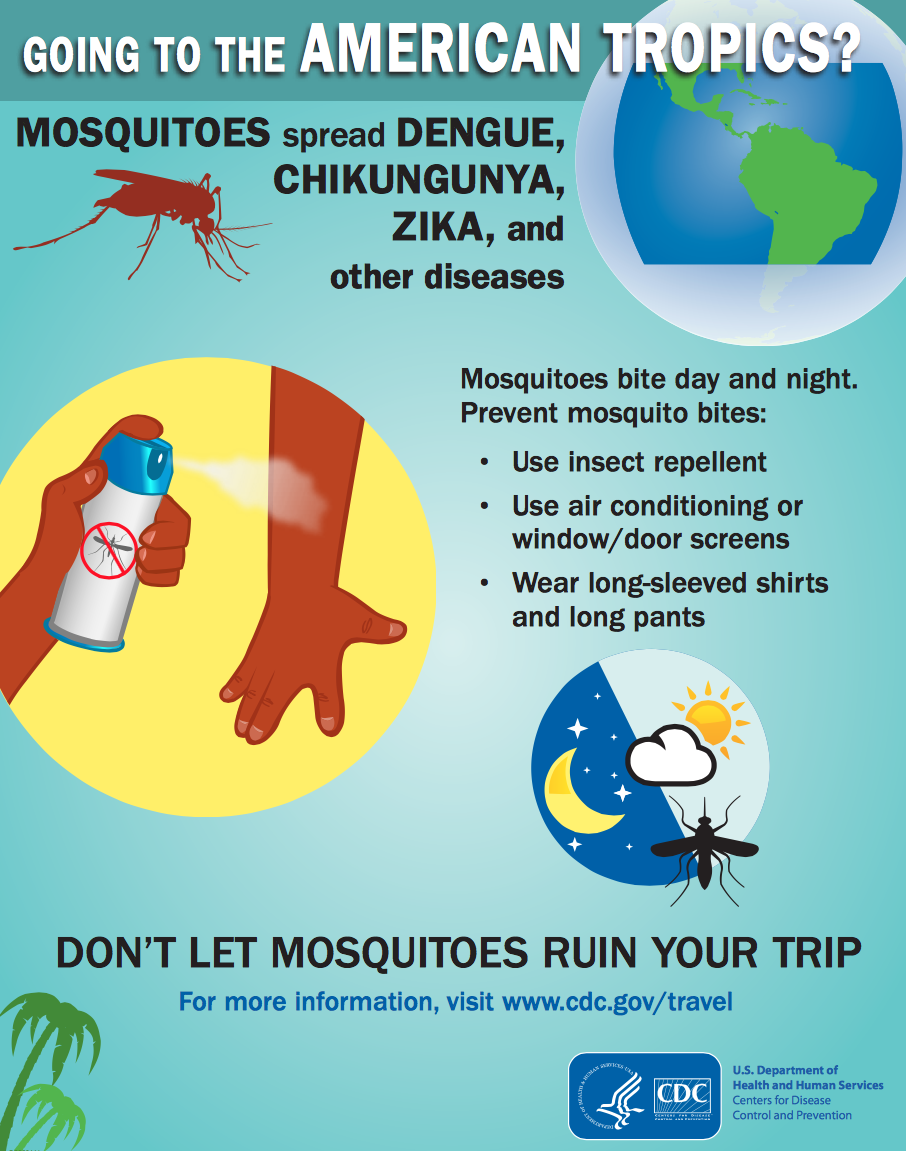
Zika virus is primarily transmitted via the bites of day-biting Aedes mosquitoes, especially Aedes aegypti. These mosquitoes do exist in the United States but mostly reside in tropical and sub-tropical regions. Aedes albopictus mosquitoes are distributed more widely in the United States and are believed to be able to carry Zika virus as well but have not been implicated to the same extent as Aedes aegypti in the current outbreak.
Only approximately 20% of people who become infected with Zika manifest symptoms. These
symptoms may include low-grade fever, conjunctivitis, rash and joint pains. These symptoms usually occur 2-12 days following a bite by an infected mosquito and symptoms typically resolve within 2-7 days. The major concern is a link to microcephaly in infants born to mothers who became infected while pregnant. In Brazil nearly 4,000 cases of microcephaly have been reported since October 2015, a greater than 20 fold increase over background microcephaly incidence.
 |
| CDC |
Zika virus infection was reported via sexual transmission (presumably via infected semen) in Texas; this is the third case of reported Zika virus transmission via sexual transmission to date. The CDC is currently recommending women who are pregnant (or trying to become pregnant) avoid travel to areas where active Zika virus transmission is occurring. They are also recommending that men who travel to transmission risk areas wear condoms for a time while in and after leaving these areas or abstain from sex. Although Zika virus appears to clear fairly rapidly from the blood of infected people it is unclear how long it may persist in semen. More information is needed to help better counsel people who have been in areas with ongoing Zika virus transmission.
Tuesday, February 2, 2016
Zika Virus Update
 |
| Countries with Zika virus transmission (CDC) |
Zika virus is a flavivirus that was only recently introduced into South America and that is spreading rapidly throughout Latin America and the Caribbean. Aedes mosquitoes (especially Aedes aegypti) are day biting mosquitoes and transmit Zika virus (as well as dengue and chikungunya, among other viruses). It is believed that the incubation period for developing disease is a few days following a bite. People who develop symptoms may have mild fever, rash, conjunctivitis, headache, malaise and arthralgia. Of high concern is a significant uptick in the number of cases of microcephaly that have been detected in Brazil during the current outbreak; these appear to be related to Zika infection although a definitive causal link has not been established. Also, Zika infection has been linked to the rare, serious neurologic condition Guillain-Barre Syndrome.
The current outbreak has been declared an emergency by the World Health Organization (WHO) and
the U.S. Centers for Disease Control (CDC) are currently recommending pregnant women avoid travel to countries experiencing Zika virus transmission.
 |
| Aedes aegypti mosquito (CDC) |
Global population growth and urbanization may have contributed to the Zika virus's emergence in the Americas. Like chikungunya just a few years before it, the virus appears to be spreading rapidly, especially in tropical and sub-tropical countries where Aedes mosquitoes exist in abundance.
Unfortunately treatment of Zika is symptom based; no specific antiviral therapies or vaccines exist at this point. Mosquito control and bite avoidance strategies will be critical in dealing with Zika virus. Looking to the future, other viruses that are transmitted by the same mosquitos could emerge; global public health planning should anticipate these events and invest in strategies to reduce such emergence.
Some excellent resources can be found online at the WHO site as well at CDC's site.
Friday, November 20, 2015
The Crisis of Antibiotic Resistance: Are We Entering the Post-Antibiotic Era?

I had a wonderful opportunity to speak at a hospital in the Richmond community this week about antibiotic resistance and stewardship; I was asked to speak by that health system's Antimicrobial Stewardship Program as part of their activities around "Get Smart About Antibiotics" week. I was asked to write up my talk so they could share it with their health system. My write-up is below.
The Crisis of Antibiotic Resistance: Are We Entering the
Post-Antibiotic Era?
In November we celebrate the CDC’s “Get Smart About
Antibiotics Week,” an event designed to raise awareness about the crisis of
antibiotic resistance and to outline possible solutions. To answer the question
of whether we are entering a post-antibiotic era: in a word, yes. But there is
hope.
Antibiotics are potentially life-saving compounds, and their
discovery has been critical to many of the medical and surgical advances we
have seen in the past 75 years. Without antibiotics patients would not be able
to survive the infectious complications of things like chemotherapy, organ
transplantation and immune suppression for rheumatologic diseases.
We truly are at a crisis point with antibiotic resistance,
especially for multi-drug resistant gram negative rods (MDR GNR). For many
patients with MDR GNR infections we have essentially returned to 19th
century medicine: in the absence of antibiotics we are left with pursuing
aggressive ‘source control’ for infected tissues, when possible. An example
would be a patient with a diabetic foot infection: whereas surgery and
antibiotics can often cure these infections, a patient with an infection with a
pan-resistant GNR may require amputation. This is not a doomsday scenario, this
is reality for many of our patients in 2015.
The CDC estimates that 2 million people acquire infections
with antibiotic-resistance bacteria yearly and 23,000 die as a direct result of
these infections. It is estimated these infections lead to upwards of 35
billion dollars in excess healthcare costs in the United States alone. These
statistics do not fully capture the scope of the problem, however, as the
morbidity associated with these infections can be significant.
Here is the problem in a nutshell: antibiotic use selects
for resistant organisms and the emergence of resistance has outpaced the
development of new antibiotics. Most of the antibiotics in use today are
natural products that organisms have been using to battle one another for
millennia; we have ‘discovered’ these and adopted them for use in humans and
animals. The antimicrobial ‘resistome’ (the resistance capacity of organisms to
overcome antibiotics) already exists in nature, presumably for most if not all
antibiotics. This is why we see resistance emerge fairly rapidly whenever ‘new’
antibiotics are deployed.
Antibiotic use extends far beyond therapeutic use in humans.
It is estimated that 70% of antibiotic use is in animals for non-therapeutic
use. Antibiotics are often used in the animal industry to grow larger, fatter
animals faster. Any solutions to the crisis of antibiotic resistance have to
span the continuum of use in both animals and humans.
Our relationship with the microbes who live on and inside is
not well understood; there is increasing evidence that there may be a symbiotic
relationship with our ‘microbiome,’ however. There are an astounding 10
bacterial cells for every 1 human cell in the human body. There is some
intriguing data that suggests altering our microbiome with antibiotics can lead
to things like allergies and obesity. Antibiotics should not be seen as
innocuous.
It is estimated 50% of all antibiotic use in human medicine
is unnecessary. The reasons for this are myriad. Front-line providers need
rapid, accurate, affordable tests to diagnose the etiology of things like upper
respiratory infections and urinary tract infections. We also need better
protocols for treating various infectious conditions informed by properly performed
clinical trials. We need better surveillance technologies to identify
antibiotic resistance and standardized, risk adjusted data on antibiotic
prescribing at the provider level.
Beyond all of the above we need new antibiotics to combat
drug-resistant bacteria. To date there is no new anti-GNR compound with a novel
mechanism of action in the antibiotic creation ‘pipeline.’ Although the FDA
approval mechanism for antibiotics has become more streamlined in recent years,
we have seen far fewer antibiotics in development. Many pharmaceutical
companies have abandoned antibiotic development altogether.
So what can be done in 2015 to combat this issue by individual
providers? First and foremost we should strive to prevent infections. Vaccinate
patients according to national guidelines, wash your hands before and after
patient contact and use appropriate contact precautions in the inpatient
environment. We can also prevent the emergence of antibiotic resistance by
optimizing our antibiotic use, especially for inpatient medicine. Record the
indication, dose and expected duration when ordering antibiotics. Take a daily
‘time out’ for each patient on antibiotics to re-assess their use and continued
need. Be aggressive with diagnostics early on to aid in de-escalation later.
And perhaps most importantly partner with your Antimicrobial Stewardship Team.
These teams exist to assist you in optimizing antibiotic use and can be a
terrific resource.
Many of our patients have already entered the
‘post-antibiotic era.’ The development of antibiotic resistance has outpaced
new drug development. The issue is complex but first and foremost we need to be
aware of just how dire the problem is and that we all have a role to play in
its solution. It has been 75 years since we saw the widespread deployment of
antibiotics. Unless major changes occur in antibiotic use and production we are
in danger of fully returning to 19th century practice for many of
our patients.
Tuesday, November 10, 2015
PK/PD in Clinical Practice
 |
| Multi-drug resistance gram-negative rods (CDC) |
Given the current crisis of gram-negative resistance and the paucity of new drugs in development it is critical that physicians learn to optimize their use of the drugs left in our armamentarium. For most antibiotics/ organisms susceptibility results are simply listed as "S"usceptible, "I"ntermediate, or "R"esistant. Oftentimes the Minimum Inhibitory Concentration (MIC) of the organism is not provided; even when these values are provided they are difficult for most physicians to interpret. What is needed is a better understanding of PK/PD principles as well as how to navigate the complex recommendations of the many organizations providing antibiotic susceptibility cutoffs.
Labreche and colleagues provide a nice overview of core PK/PD principles and also discuss the different agencies that provide breakpoints for different organisms and drugs (FDA, CLSI, EUCAST). For the latter, differences in how the organizations come up with recommendations are highlighted. Several useful examples of recent changes are provided and how these changes can be applied to clinical practice.
Thursday, June 11, 2015
VCU GH2DP Outreach Trip to Yoro, Honduras: Summary
 |
| Traveling to La Hicaca |
Since 2005 we have been working with approximately 17 villages with little to no access to medical care.
 |
| Medicine Clinic in Lomitas |
 |
| Assembling water filters |
 |
| Testing new water catchment device |
 |
| With Dr. Pat Mason and Dr. Ana Sanchez working on our deworming project |
 |
| Internal Medicine team, Lomitas |
 |
| Dr. Jason Cook working on water chlorination system project |
 |
| GH2DP Outreach Team, La Hicaca |
 |
| GH2DP Pathway Residents and Student Scholars |
Friday, June 5, 2015
GH2DP Outreach Trip: Day 2

A major focus of our health outreach work focuses on de-worming. Last year stool testing revealed a high prevalence of whipworm infection despite de-worming with a single dose of albendazole twice yearly. In addition to continuing surveillance we have changed our de-worming protocol to better target whipworm and have initiated a new de-worming tracking project.
After this morning there will likely be no new posts until we get back from the mountains. Will share more about our trip when we return.
Thursday, June 4, 2015
GH2DP Outreach Trip to Yoro, Honduras
Today is day one of our outreach trip to rural Yoro, Honduras, on a medical and public health outreach trip with VCU's Global Health and Health Disparities Program (GH2DP).
 The U.S. contingent of our group left early this morning and has arrived in San Pedro Sula. In addition to our group we have approximately 950 pounds of gear and supplies we will transport to Olanchito and organize tonight.

Our plan is to meet the rest of our group and transport our team and supplies up to the rural, mountainous village of La Hicaca tomorrow. From here we will stage our medical and public health outreach work.
Subscribe to:
Posts (Atom)