Showing posts with label malaria. Show all posts

Sunday, December 30, 2012

New Study Explores Relationship Between Biodiversity, Vector-borne Diseases and Economics

Aedes aegypti mosquito (one
of the mosquitoes that carries
the dengue virus; cdc.gov)
Here is an interesting article by Bonds and colleagues in PLOS Biology. Via creative statistical modeling techniques, these authors examined the relationship between the 'latitudinal gradient in income' (the fact that there are more poor people living in the tropics) and vector-borne and parasitic diseases (diseases like malaria that are carried by mosquitoes).

The authors found that vector-borne diseases (VBDs) have significantly affected economic development, and that VBDs are affected by underlying ecologic conditions, especially biodiversity. Interestingly, their model predicts that the burden of VBDs will rise (and local economies will suffer) if biodiversity falls.

Dengue risk map (for past 3 months); tropical areas are
disproportionately affected by many tropical infections;
www.healthmap.org/dengue/index.php
An example of a VBD is dengue, a viral disease carried by mosquitoes (the disease 'vectors'). Both the dengue virus and its mosquito vectors are influenced by local ecosystems. One example of how influencing an ecosystem can affect a VBD is the release of genetically altered mosquitoes into an area to help control the spread of dengue disease. This practice has been used in multiple locations to control dengue spread via limiting the local mosquito population's ability to reproduce.

An example of a VBD that has potentially emerged due to relatively poor biodiversity is Lyme disease; this is a bacterial infection carried by ticks; there were over 24,000 cases in the US in 2011.

The authors note that diverse, well-functioning ecosystems may have a positive effect on the health of a given population via decreasing the burden of vector-borne diseases. This, in turn, will positively affect a given area's economy. This research is intriguing and more research into the relationship between the burden of VBDs and ecology is warranted.

Thursday, December 20, 2012

Fake Malaria Drugs: Driving Resistance and Killing Patients

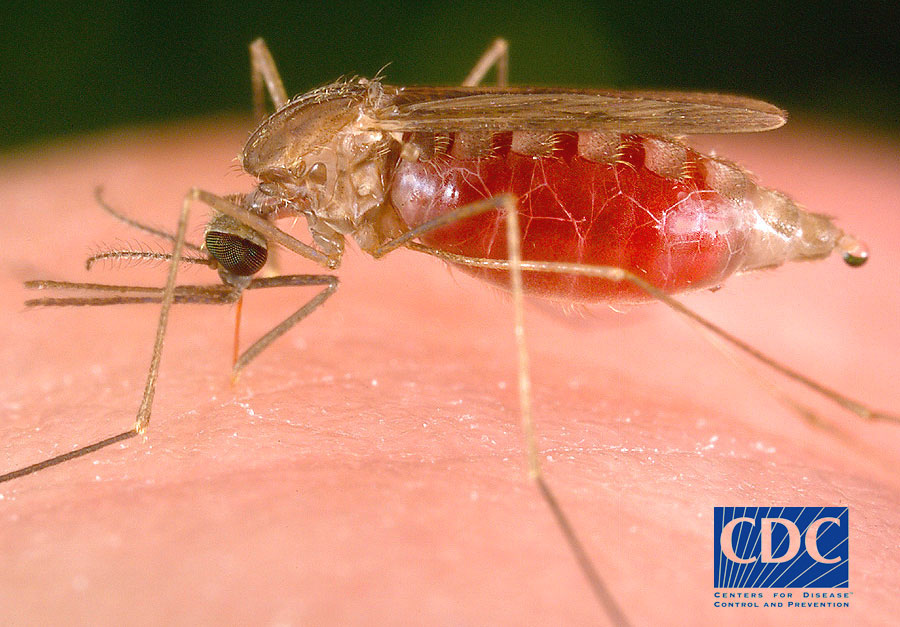
Anopheles mosquito (the mosquito that carries
malaria) taking a meal
Here is a disturbing NPR report on fake malaria drugs. The article highlights the issue of counterfeit malaria drug use and how this has a negative impact on patients and drives drug resistance.

Malaria, a parasitic disease carried by mosquitoes that destroys red blood cells, is a major cause of worldwide morbidity and mortality (killing over 600,000 people per year).

There is a criminal industry focused on producing fake malaria drugs. As malaria can be deadly (and people can die quickly), this industry directly compromises patients' lives. Some of these false drugs actually contain low levels of active anti-malarial compounds-too low to cure the infection but high enough to allow the parasite to develop drug resistance.

The NPR article links to a study by Newton and colleagues published in 2008. In this study they examined 391 samples of the anti-malaria drug artesunate collected in Southeast Asia and found that approximately 50% contained no or very small levels of this compound. Some of the compounds that were detected were potentially dangerous: these included a carcinogen and raw material for the street drug 'ecstacy.'

This is a problem that extends beyond malaria drugs: as I previously noted, up to 50% of medications in some countries for life-threatening diseases may be fake. A major issue is our poor understanding of the scope of this problem.

The problem of malarial drug resistance is a major one: we only have a few anti-malarial drugs as it stands. If resistance to these compounds becomes more widespread than more patients will die. We need to preserve the drugs we have left, including combating such diabolical practices as creating fake or profoundly substandard anti-malarial medicines.


Monday, December 17, 2012

A History of Malaria Drugs: In Under 3 Minutes

An Anopheles mosquito (the vector for malaria
parasites; cdc.gov) 
Here is a very nice short video appearing over at NPR on the history of malaria, anti-malaria drugs and increasing malaria drug resistance. If the link above is sluggish the video can also be seen on YouTube. This is well worth taking a look at.

More On the Malaria Vaccine: Q&A with Sir Brian Greenwood

Plasmodium falciparum (malaria) parasites within
red blood cells (cdc.gov) 
Here is a nice Q&A piece with Sir Brian Greenwood on the recently reported (RTS,S) phase 3 malaria vaccine trial.

As previously discussed, malaria is a parasitic disease carried by mosquitoes that destroys red blood cells and is associated with high global morbidity and mortality (leading to over 600,000 deaths per year).

Greenwood provides a nice overview of malaria as well as a brief history of prior malaria vaccine efforts. He also discusses how to interpret the RTS,S trial results and their implication for future malaria vaccine work. Although the RTS,S vaccine does not appear to be as effective as initially hoped, this work does provide hope that an effective malaria vaccine is possible.


Thursday, December 6, 2012

Malaria Vaccine Report: Hope on the Horizon?

Where malaria occurs (cdc.gov)
Here is a study recently published in the New England Journal of Medicine on the "RTS,S/AS01" vaccine against malaria.

Malaria, a parasitic disease carried by mosquitoes that destroys red blood cells, is still a major cause of worldwide morbidity and mortality (responsible for over 600,000 deaths per year) and an anti-malaria vaccine has been seen by many as the 'holy grail' of public health.

This study follows up one published in 2011 that noted a vaccine efficacy of 45% (95% CI 23.8-60.5) for severe malaria in children aged 5-17 months. The current trial looked at vaccine efficacy for children 6 to 12 weeks of age and found a much lower (not statistically significant) efficacy of 26% for cases of severe malaria in the intention-to-treat analysis (95% CI -7.4 to 48.6). 

Malaria parasites in red blood cells (cdc.gov)
Why the difference in efficacy between the two age groups? The authors posit the lower efficacy rate in younger children may have been due to a less mature immune system or to co-administration with other vaccines. 

Why has creating a malaria vaccine proved so elusive? In a nice editorial that accompanies the above article, Johanna Daily outlines some of the challenges we have encountered to date in creating a malaria vaccine. These include malaria's long coevolution with humans, which has produced a robust parasite that is adept at avoiding destruction by our immune system, as well as an incomplete understanding of our immune response to the organism (which would provide insight into vaccine development). 

Of note, malaria is another organism where drug resistance is a major problem. Given the serious, life-threatening nature of malaria infections, and the paucity of drugs available to treat these, malaria drug resistance is a major global problem. 

Although the RTS,S/AS01 vaccine does not appear to be "ready for prime time," it does provide hope that an effective malaria vaccine can be produced. Given the global morbidity and mortality associated with this disease, continued intense research into malaria vaccine development is warranted.